

Initiating its services in 1996, Dünyagöz Hospitals Group brings solutions to all kinds of problems related to ocular and periocular health with 500 of different treatment methods provided in all eye-related branches. Beginning a new era with branch hospital services in Turkey, Dünyagöz Hospitals Group provides its health services both domestically and internationally at a total of 29 different locations with 8000 policlinics and 1000 surgical operations.
Dünyagöz has become the medical reference center of the world within a short time, with technology, its medical staff of 300 members consisting of lecturers and specialists, and its staff of 3,500 employees.
Dünyagöz Hospitals Group offers eye-care services with 21 branches in 12 provinces throughout Turkey’s central Anatolia, it’s north, south and west, and also provides services in 8 different international locations in Frankfurt and Köln, Germany; in Tbilisi, Georgia; in Baku, Azerbaijan; in Bishkek, Kyrgyzstan; in Sarajevo, Bosnia-Herzegovina and Pristina, Kosovo, as well as in Bulgaria and Romania. Intending to expand its operations to an even wider region with 2023 while maintaining the pace of its investments and leading the health tourism activities in Turkey, the Group offers services for approximately 110,000 patients a year from 160 foreign countries around the world.
Dünyagöz is intending to continue its investments abroad at the same pace and aims to expand to a wider geography with the arrival of 2023. By taking the lead in medical tourism in Turkey and serving an average of 110 thousand patients from 160 different foreign countries of the world annually, Dünyagöz has been awarded Turkey’s “500 Top Service Exporter” Certificate of Achievement. Dünyagöz aims to increase the volume of health tourism with its new breakthroughs abroad in 2023.
Intraocular lens treatment is a surgical procedure used for eye problems, such as cataracts (clouding of the natural lens). This procedure involves placing a special lens inside the eye to improve a patient’s vision and, if applicable, correct refractive errors (myopia, hyperopia, astigmatism). Intraocular lens treatment allows ophthalmologists to create personalized treatment plans tailored to individual patient needs using various lens options.
Advantages of intraocular lens surgery
Treatment of refractive errors: Intraocular lens surgery is an effective method for correcting refractive errors such as myopia, hyperopia, and astigmatism.
Cataract treatment: Additionally, intraocular lens surgery offers an option for people with cataracts. During cataract surgery, the natural lens is removed and replaced with an artificial lens. Therefore, people undergoing lens surgery for dioptries correction may also have cataract treatment, potentially preventing cataract development in the future.
Customized treatment: Intraocular lenses come in various focal lengths and designs, providing customized treatment options to meet the individual needs of patients.

Trifocal intraocular lens surgery is a procedure where the eye’s natural lens is removed and replaced with a smart lens, known as a trifocal lens. Successfully implanted lenses in the eye are frequently preferred, particularly in cataract patients. The types of intraocular lenses used in the medical field are divided into three different categories:
Trifocal lenses, commonly known as smart lenses or smart intraocular lenses, are lenses with three focal points. The purposes of using these lenses may vary depending on the patient and the progression of the disease. The suitability of which lens is appropriate for which eye can be determined based on a detailed examination performed by a specialist opthalmologist.
What is trifocal intraocular lens?
A trifocal lens, which treats vision impairments at far, near, and middle distances, is an intraocular lens implanted in place of the deformed natural lens. This lens can focus at both far and near distances, as well as the middle distance. Therefore, it aims to correct vision problems at every distance.
Who is suitable for trifocal lens surgery?
Trifocal lens surgery can be performed on people with vision impairments in both far and near vision, as well as those who are undergoing cataract treatment, provided that their eye structures are suitable. When looking at general vision problems, advanced vision impairments can occur even at a young age. However, refractive errors such as myopia, astigmatism, and hyperopia can be treated with laser surgery at a young age and with intraocular lenses at later ages.
Trifocal lens (intraocular lens) surgery can be performed on:
Patients with astigmatism (by adding toric features)
Patients with both far and near vision problems (myopia and hyperopia)
Patients with cataracts.

Phakic lens treatment is the placement of a transparent lens inside the eye that is compatible with the eye’s natural tissue when laser treatment is not possible for refractive errors such as myopia, hyperopia, and astigmatism.
Firstly, during a comprehensive examination performed by an ophthalmologist, the refractive error of the eye and its degree is determined. Special devices are used to measure whether the anterior chamber depth of the eye, where the lens will be placed, is sufficient for the procedure. After evaluating the corneal tissue, a decision will be made regarding the suitability of the eye for phakic lens surgery.
To whom can be applied phakic lens treatment?
can be treated.
PHAKIC lens surgery:
Local anesthesia is applied before the surgery to ensure that patients do not feel pain and do not move their eyes during the operation. The surgery takes approximately 20 minutes for each eye. During the surgery, a small incision is made in the corneal layer to place the lens. It does not require hospitalization. After the surgery, the patient is kept in the room for 1-2 hours. Afterward, the patient can be discharged. The eye remains bandaged on the day of the operation. The bandage is removed when the patient comes for a check-up the next day.
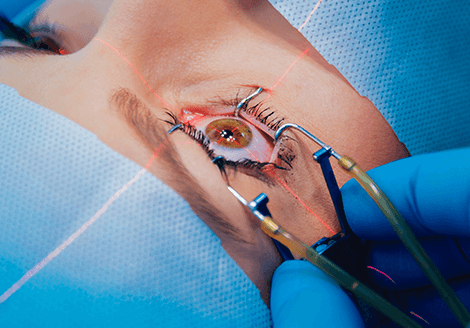
Our natural lens inside the eye has a refractive strength of +10 diopters. Our natural lens adapts to near vision and gains a strength of +3 when looking at close objects until around the age of 40. As we reach our forties, we start to lose our ability to adapt to near vision and begin to need reading glasses. When the natural lens becomes cloudy, it is called cataract. When cataracts are removed through surgery, the eye loses its original refractive power of 10 for far distance and 13 for near distance. This is why intraocular lenses are implanted inside the eye during cataract surgery to provide the eye with the necessary refractive strength.
How many types of intraocular lenses are there?
Before intraocular lenses are implanted into the eye, their strengths need to be determined. Just like prescription eyeglass lenses, intraocular lenses also have refractive strengths. A comprehensive eye examination, including lens power calculation and measurement using specialized devices, is performed by an ophthalmologist to determine the strength of the lens to be implanted. Both monofocal and multifocal lenses, such as trifocal lenses, require accurate measurements.

Your comfort is our priority throughout your treatment process!
Initiating its services in 1996, Dünyagöz Hospitals Group brings solutions to all kinds of problems related to ocular and periocular health with 500 of different treatment methods provided in all eye-related branches. Beginning a new era with branch hospital services in Turkey, Dünyagöz Hospitals Group provides its health services both domestically and internationally at a total of 29 different locations with 8000 policlinics and 1000 surgical operations. 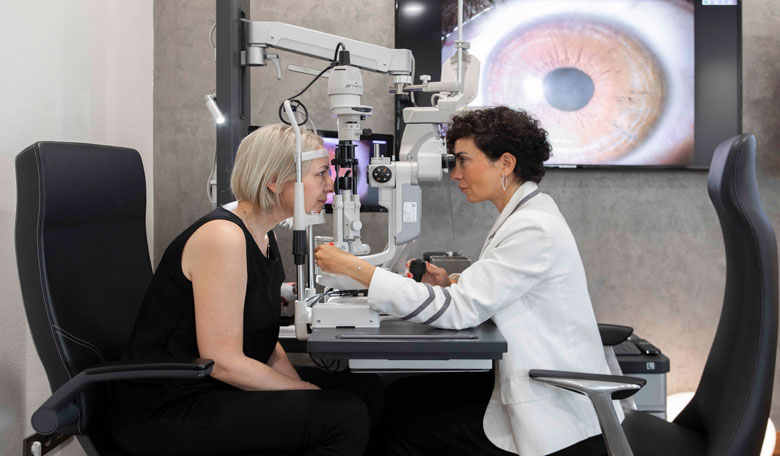
This is a list of frequently asked questions that may help you understand more about the procedure.
Intraocular lens treatment can be applied to many patients with refractive errors (myopia, hypermetropia, astigmatism) or cataracts. However, every patient is unique, and the suitability of this treatment should be determined through a detailed examination by an ophthalmologist. Factors such as age, health status, and eye structure are taken into consideration when identifying suitable candidates for intraocular lens treatment.
Trifocal lenses are permanent. The patient’s dioptries are stabilized with trifocal lenses, and the patient can use the same lens throughout their lifetime without any deformity. Therefore, it is important to make the correct lens selection before the surgery.
Like any surgery, trifocal lens surgeries have various risks. However, the success of the surgery is related to factors such as the experience and expertise of the team and the ophthalmologist, as well as the quality of the lens used. Therefore, with an experienced team and ensuring all suitable conditions for the surgery, these risks can be minimized, and successful results can be achieved.
The goal of Trifocal lenses is to make the patient completely independent of glasses after the surgery.
Before the surgery, the eye is numbed with a local anesthetic eye drop, reducing the patient’s sensation of pain and discomfort during the operation.
Patients can generally be discharged on the same day of the surgery.
Laser surgery, such as smart lens or trifocal lens surgery, is not an obstacle. However, if a patient has undergone laser treatment, commonly known as “eye correction”, and continues to experience vision problems afterward, it can create some measurement errors when considering trifocal lens surgery. Therefore, it is important to undergo a thorough examination and consult an experienced ophthalmologist
After the surgery, the eye is bandaged. The bandage is usually removed within a few hours, and the patient can start seeing immediately. The quality of vision improves every day, but full vision is usually achieved within about one month.
Trifocal lenses are generally recommended for patients aged 45 and above. However, they can also be used for younger patients with advanced vision problems or early cataracts.